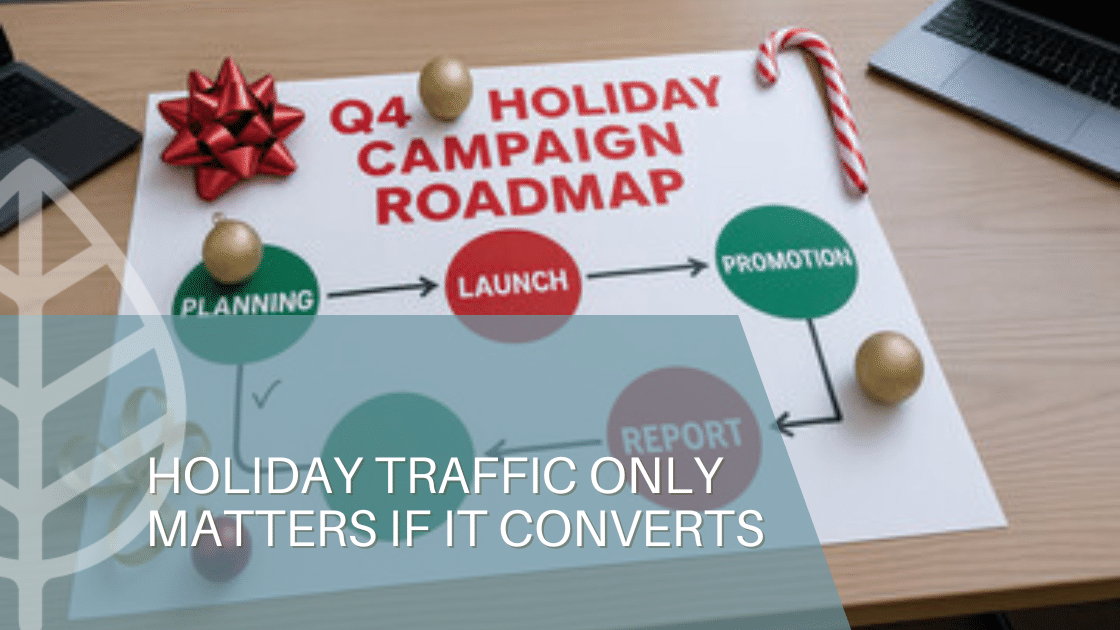
Holiday Traffic Only Matters If It Converts: Mobile Pages, Promotion Clarity, and Friction Reduction for Orlando Businesses

Traffic is not revenue. This distinction is easy to lose sight of during Q4 when session counts climb and it looks like the marketing is working. But an Orlando business that drives strong holiday traffic to a website that loads slowly on mobile, buries its offer, and presents a confusing contact process is not winning Q4; it is spending money to fill a leaky bucket. The businesses that actually close the holiday season strong are not the ones with the most traffic; they are the ones whose traffic actually converts. This is the Q4 problem that most businesses underestimate until they review the numbers in January.

The Mobile Reality of Holiday Search

The majority of holiday search activity happens on mobile devices. Consumers search from their phones while commuting, while shopping, while watching television, and while waiting in line. A website that was built to look good on a desktop screen but loads slowly or displays awkwardly on a phone is losing the majority of its holiday traffic to competitors whose mobile experience is clean and fast. Google’s Core Web Vitals metrics directly measure mobile performance and factor it into search rankings, which means a poor mobile experience suppresses both the quantity of traffic arriving and the percentage that converts. The most common mobile issues on Orlando business websites include pages that take more than three seconds to load, fonts that require pinching and zooming to read, buttons and form fields that are too small for reliable thumb navigation, and pop-ups that cover the content on entry. These are fixable problems. Our technical SEO team identifies and corrects them before Q4 traffic arrives, not after it has already bounced.

Promotion Clarity: What Your Holiday Offer Actually Communicates

A holiday promotion that requires reading three paragraphs to understand is not a promotion; it is an obstacle. Holiday buyers are moving quickly, comparing multiple options, and making decisions under the time pressure of seasonal deadlines. If the answer to “what do I get, and what does it cost?” is not available within the first ten seconds of visiting your page, many of them will leave before they find it. Promotion clarity means the offer is stated in the headline or within the first visible block of text, the value is expressed in plain terms rather than marketing language, the terms are simple enough to scan rather than requiring careful reading, and the next step is a single obvious call to action rather than a menu of options. Our AI marketing and copywriting team rewrites holiday offer pages for this kind of clarity, and the impact on conversion rates is consistently the highest-leverage change a business can make before Q4 peaks.

Friction Reduction: The Hidden Conversion Killers

Friction is anything between a visitor’s intent to convert and their completion of the conversion. The most common friction points on Orlando business websites during the holiday season are contact forms that ask for more information than the business needs to follow up, phone numbers buried in the footer rather than visible in the header and on key pages, no direct booking or scheduling option for service businesses when competitors offer one, redirect chains that add load time between the ad click and the landing page, and a lack of reassurance signals such as reviews, certifications, and response time commitments near the conversion point. Each of these friction points reduces the percentage of visitors who complete the intended action, and during Q4 when traffic volume is at its peak, the cumulative revenue cost of uncorrected friction is significant. Our Google Ads and landing page team runs conversion audits that identify and prioritize friction points by estimated revenue impact.

Retargeting: Converting the Visitors Who Left

Not every qualified holiday visitor converts on their first visit. Some leave to compare options. Some are interrupted. Some are still in the research stage and will return when they are ready to decide. Without retargeting in place, those visitors are simply gone. With retargeting, you serve ads to them as they continue browsing across the web and on social media, keeping your business visible and offering a reason to return. Holiday retargeting campaigns that serve a specific offer to visitors who viewed a specific page are consistently among the highest-return paid advertising programs available to local businesses. The audience is already qualified by their first visit; retargeting simply closes the loop. Our social media and paid advertising team builds and manages retargeting programs alongside the primary paid campaigns so that the traffic you earn works twice rather than once.

Turning Q4 Traffic Into Q4 Revenue

The businesses that will review Q4 as a genuine win are not the ones that got the most visitors; they are the ones that converted their visitors at the highest rate. Mobile performance, offer clarity, friction reduction, and retargeting are the four levers that determine conversion rate, and all four can be improved before the holiday traffic peaks. The time to make these improvements is now, while there is still room to test, adjust, and confirm that the changes are working before the window closes. Call The AD Leaf Orlando at (407) 374-9919 or reach out through our contact page to talk through a conversion audit for your holiday season

Year-End Marketing ROI for Orlando Businesses: Make Q4 Count and Plan Q1 Right

The final quarter of the year is the most expensive and the most consequential marketing window for most Orlando businesses simultaneously. Ad costs are elevated, consumer attention is at its annual peak, and the decisions a business makes about where to spend its marketing budget have a disproportionate impact on results compared to any other quarter. Getting Q4 right is not just about closing the year strong; it is also about building the campaign history, audience data, and organic visibility that will carry the business into Q1 with momentum instead of starting over from zero in January.

Why ROI Thinking Matters More in Q4 Than Any Other Quarter

In Q2 or Q3, a marketing experiment that does not work costs the budget for a month and produces a data point for the next attempt. In Q4, a campaign that misses during the holiday window costs the budget for the quarter plus the seasonal opportunity that will not return for twelve months. The stakes are not the same, which is why the standard approach of “launch it and see what happens” is exactly wrong for Q4. Every dollar spent during the holiday window should have a defined purpose, a measurable outcome, and a conversion path that has been tested and optimized before the most expensive traffic of the year hits it. Our Google Ads team builds Q4 campaigns with this logic from the first dollar rather than discovering conversion issues after the budget is spent.

Service Comparisons That Help Orlando Buyers Decide Faster

One of the most underused content types for Q4 is the service comparison page: a page that directly addresses how your services compare to alternatives, what you do differently, and why a buyer in your category should choose you over a competitor. Holiday buyers are conducting more research than casual shoppers, and they are more likely to read a comparison if it answers the questions they are actually asking. A business that publishes clear, honest comparison content earns credibility with high-intent buyers who have already narrowed their options and are in the final decision stage. Our AI marketing and content team builds this content type efficiently, making it feasible to have relevant comparison pages live before the holiday decision window peaks.

The Year-End Budget Decision and What It Signals About Q1

Many Orlando businesses reach December with unspent marketing budget and a question about whether to push it into Q4 campaigns or hold it for Q1. The answer depends heavily on how Q4 preparation was handled. A business with campaigns already performing, audiences already built, and seasonal content already indexed can profitably push additional budget into December. A business that has not done the preparatory work cannot turn a larger budget into proportionally better results at the last minute; the infrastructure that makes spending efficient is not in place. For businesses in the latter situation, the more valuable move is to use December to build the Q1 foundation: SEO groundwork, campaign testing, audience development, and content that will generate organic returns by February. Our SEO services for the Orlando area are structured to compound over time, which makes starting in December more valuable than waiting until January.

What a Strong Q4 Builds for Q1

The businesses that have the strongest Q1 are almost always the ones that ran strong Q4 campaigns with proper tracking and conversion data. A Google Ads campaign that ran through the holiday season accumulates Quality Score improvements, negative keyword lists, and audience segments that make the same budget work harder in Q1. An organic content program that published consistently through Q4 has pages that continue to accumulate ranking authority through January and February. Email and SMS lists grown through holiday promotion campaigns can be reactivated for Q1 offers to an audience that has already demonstrated purchase intent. These compounding benefits are why the businesses that invest properly in Q4 do not start Q1 from scratch. Our social media programs are built to sustain audience engagement through the holiday-to-new-year transition rather than allowing the community built in Q4 to go cold in January.

Building the Plan Before the Clock Runs Out

There is a narrow window between now and the point where Q4 preparation becomes Q4 scramble, and the difference between the two is whether the foundational work is done in time to compound. SEO content needs time to index. Campaigns need time to optimize. Audiences need time to build. Every week of delay in starting Q4 preparation is a week of compounding returns that cannot be recovered. The businesses that will close Q4 strong and enter Q1 with momentum are the ones making these decisions now, not in late November. Call The AD Leaf Orlando at (407) 374-9919 or reach out through our contact page to start building your Q4 plan while the preparation window is still fully open.

Get Ahead of Holiday Demand: What Orlando Businesses Should Be Doing Right Now

Every year, the same pattern plays out for a significant portion of Orlando businesses. The holiday season arrives, search traffic and consumer spending spike, and the businesses that scramble to get campaigns running or seasonal pages built are already behind the ones that prepared weeks earlier. This is not an accident of timing; it is the predictable outcome of a well-understood problem. The businesses that win Q4 do not start in Q4. They start before it, and the preparation window is narrowing right now.

The Indexing Problem That Kills Last-Minute Holiday SEO

Google does not rank new pages instantly. When you publish a seasonal landing page, a holiday service page, or a gift guide blog post, the search engine needs time to crawl, assess, and assign that content a ranking position for relevant queries. This process typically takes four to eight weeks for a page on a well-maintained site with good technical health. A page published in mid-November may not rank meaningfully until the first week of January, which means the entire holiday window has closed before the content does any work. The solution is not to publish faster in November; it is to publish earlier, which means the work of building seasonal content needs to happen in October or sooner. Our SEO team in Central Florida builds and publishes seasonal content on a timeline that accounts for this indexing reality, so the pages that should rank during the holidays actually do.

What Happens to Advertising Costs During the Holiday Window

Paid advertising on Google and Meta becomes more expensive in Q4 because every business from local competitors to national brands with enormous budgets is running holiday campaigns simultaneously. The cost per click for high-intent commercial keywords can increase by 30 to 60 percent between October and December compared to the summer average. Businesses that wait until November to build their campaigns are not just late; they are paying premium prices for cold campaigns without the optimization history and audience data that makes paid advertising efficient. A campaign running since September has weeks of performance data, refined audiences, and improved Quality Scores working in its favor by the time the most expensive traffic window opens. Our Google Ads program is built on this logic: campaigns performing before the peak are campaigns that return a better holiday ROI.

The Three Most Common Holiday Prep Failures

Most of the businesses that struggle in Q4 fall into one of three patterns. The first is no seasonal content, which means the business has no pages targeting the specific search terms consumers use during the holiday window and no blog content addressing holiday questions in their category. The second is a slow or broken mobile experience, which loses the majority of holiday traffic since most consumers search and browse on their phones. A page that loads in more than three seconds loses a significant share of mobile visitors before they have read a word. The third is unclear offers and buried conversion paths, where a consumer who is ready to book or buy cannot figure out how to do so quickly. All three of these problems are fixable, and all three need to be fixed before the holiday window opens rather than during it. Our AI and content team addresses all three as part of Q4 preparation.

Orlando’s Unique Holiday Market Characteristics

The Orlando market has several characteristics that make Q4 preparation especially important. The influx of holiday tourists visiting the theme parks increases consumer activity across virtually every business category, from restaurants and retail to services and experiences. Families visiting Orlando are often spending more freely than they would in their home cities, and a well-positioned local business can capture a meaningful share of that visitor spending if the digital presence is ready for it. The return of university students to the area and the traditional seasonal pattern of year-end spending among residents add to a Q4 consumer environment that is more active than almost any other period. Businesses that are not visible and well-positioned in October are leaving money on the table by November. Our social media team helps Orlando businesses stay visible across every channel where holiday consumer attention lives.

The Prep Checklist Before November Arrives

For an Orlando business heading into Q4, the preparation checklist should include seasonal landing pages published and submitted to Google Search Console for faster indexing, Google Business Profile updated with holiday hours, seasonal photos, and any promotional posts, Google Ads campaigns for holiday intent keywords built and live, mobile page speed tested and issues corrected, review acquisition accelerated through existing satisfied customer outreach, and email or SMS promotional sequences drafted for Black Friday through year-end. The businesses that have all of these running by late October will spend November and December collecting results while competitors spend those months building infrastructure that should have been done weeks earlier. Call The AD Leaf Orlando at (407) 374-9919 or visit our contact page to talk through what your Q4 preparation should look like.

Why Your Google Business Profile Is Your Most Underused Marketing Asset

Most Orlando small business owners have a Google Business Profile. Most of them set it up once, verified the address, and never looked at it again. That is a significant missed opportunity, because a well-managed GBP is often the single highest-leverage digital marketing asset a local business has available, and it is free.

When someone in Orlando searches for what you offer, your Google Business Profile determines whether you appear in the local map pack at the top of results, what they see when they find you, how much they trust you before visiting your website, and whether they call you or a competitor. The businesses consistently appearing in the top three map pack positions in competitive Orlando categories are not there because they got lucky. They are there because their GBP is actively managed and optimized, and their competitors’ are not.

What Most Business Owners Get Wrong About Their GBP

The most common mistake is treating a Google Business Profile as a directory listing rather than a dynamic marketing channel. A directory listing is static: you fill in your name, address, phone number, and hours, and leave it. A well-managed GBP is updated regularly, responds to customer questions, publishes posts about promotions and events, uses every available field to communicate what makes the business worth choosing, and actively generates reviews from satisfied customers. The difference in local ranking performance between these two approaches is substantial.

The second common mistake is assuming that because the GBP was set up correctly at launch, it is still correct now. Google allows anyone, including competitors and customers, to suggest edits to your profile. Business hours, addresses, and categories can change without notifying you. Unmonitored profiles accumulate inaccuracies that suppress rankings and confuse potential customers who show up at the wrong time or place.

Category Selection: The Highest-Leverage Setting Most Businesses Get Wrong

Your primary category is the single most important ranking signal in your Google Business Profile. Google uses it to determine which local searches your business is eligible to appear in. Choosing the wrong primary category, or choosing a generic one when a more specific option exists, limits your visibility for your most important queries.

For example, a business that provides both general digital marketing and specialized local SEO services should evaluate whether “Digital Marketing Agency” or “Marketing Consultant” or a more specific category better matches how their target customers search. The right answer depends on search volume and competitive density in the Orlando market for each option. Getting this right, and selecting the correct secondary categories to capture adjacent searches, is one of the fastest improvements available to a business with an underperforming GBP. Our local SEO team evaluates category strategy as part of every GBP optimization engagement.

Photos: More Important Than Most Businesses Realize

Travel photos and vintage camera in warm sunlight

Google Business Profiles with more photos consistently receive more clicks, direction requests, and website visits than profiles with few or outdated images. Photos also influence how authoritative and established a business appears before a customer has visited the website or read a single review. For businesses in industries where visual presentation matters, such as restaurants, retail, healthcare, and professional offices, photo quality directly affects conversion from profile view to contact. This is especially true when customers are comparing your profile against competitors running Google Ads at the top of the same results page.

This means regularly adding new photos of your space, team, products, and work, not just a handful of images at launch. It also means monitoring the photos that customers add to your profile, because Google allows users to upload photos that you cannot control. A few poor-quality or unrepresentative customer photos can undermine an otherwise strong profile.

Google Posts: A Publishing Channel Almost Nobody Uses

Google Business Profile allows businesses to publish posts that appear directly in the local knowledge panel when someone searches your business. These posts can highlight promotions, announce events, share new services, or simply reinforce what makes your business worth choosing. They expire after seven days for most post types, which means the businesses that publish regularly maintain fresher, more active-looking profiles than those that never post at all.

Publishing frequency is a signal Google uses to assess how actively managed a profile is. Profiles that are updated regularly with posts, new photos, and accurate information tend to rank better than static ones in the same category and location. For an Orlando business investing in local SEO, maintaining a publishing cadence on GBP is one of the lowest-cost, highest-return maintenance tasks available. This complements the broader content marketing work we do for clients across Central Florida.

Frequently Asked Questions About Google Business Profiles

How many reviews do I need to rank in the Orlando local map pack?

There is no fixed number, because the threshold depends entirely on your specific category and location. In some Orlando niches, 30 to 40 recent reviews with a rating above 4.5 is enough to compete at the top of the local pack. In highly competitive categories like legal, HVAC, or cosmetic dentistry, the top-ranked businesses may have hundreds of reviews. The relevant benchmark is not an absolute number but your position relative to the businesses currently ranking above you. A competitor analysis shows you exactly what you need to build toward.

Can competitors damage my Google Business Profile?

Yes. Google allows users to suggest edits to business information, and those edits can go live without the business owner being notified. In competitive verticals, some businesses face deliberate manipulation of their GBP by competitors who suggest incorrect hours, addresses, or categories. Regular monitoring of your profile for unauthorized changes is an important part of maintaining your local search presence. Businesses in highly competitive Orlando categories should have someone reviewing their GBP weekly.

Should I respond to every Google review, including positive ones?

Yes. Responding to reviews, both positive and negative, signals to Google that your profile is actively managed, and it signals to potential customers that you are attentive and engaged. For negative reviews, a professional, constructive response that addresses the concern without being defensive is often more persuasive to a prospective customer reading your reviews than a five-star review on its own. How a business handles a problem tells potential customers more about what working with that business is like than how it handles things when everything goes smoothly. Our reputation management services include review response frameworks and monitoring for Orlando businesses that want this handled professionally.

Does my Google Business Profile affect my website’s organic rankings?

GBP optimization and organic SEO are related but separate ranking systems. A strong GBP improves your visibility in the local map pack but does not directly boost your organic website rankings. However, the underlying signals overlap considerably: consistent NAP information, strong review authority, and a clear entity identity all benefit both your GBP performance and your organic SEO. Investing in one creates conditions that support the other, which is why our local SEO services address both in an integrated program rather than treating them as separate workstreams.

The Q&A Section: A Ranking Signal Most Businesses Ignore Entirely

Google Business Profile includes a Q&A feature where anyone can ask questions about your business and anyone can answer them. Many business owners do not know this feature exists, which means competitor-supplied answers, incorrect information from well-meaning customers, or simply unanswered questions are sitting on their profile and influencing purchasing decisions.

The correct approach is to proactively populate your own Q&A section with the questions your potential customers most commonly ask, answered clearly and accurately by you. Google rewards this with additional profile completeness signals, and it helps potential customers find the information they need before calling or visiting. It is also a source of structured content that AI search systems pull from when generating local recommendations.

Putting It All Together

A Google Business Profile managed at the level most Orlando businesses are managing theirs is a missed opportunity. A GBP managed correctly, with intentional category selection, regular photo updates, consistent posts, active review generation, monitored Q&A, and prompt response to reviews, is a meaningful competitive advantage in a market where most competitors are leaving the same table stakes on the table.

The investment required is not enormous. The discipline required is consistency: treating the GBP as an active marketing channel that gets regular attention rather than a set-it-and-done directory listing. For businesses that want professional management of their GBP as part of a broader local SEO program, The AD Leaf’s local SEO services cover GBP optimization and ongoing management as a core component. Our AI marketing team also ensures that the entity signals built through GBP work extend into AI search visibility across ChatGPT, Perplexity, and Google’s AI Overviews.

Let Us Audit Your Google Business Profile

If you are not sure whether your GBP is working as hard as it should be for your Orlando business, we can tell you. The AD Leaf reviews GBP setup, category selection, review position, photo quality, post activity, and competitive positioning as part of a straightforward local SEO audit. Call us at (407) 374-9919 or contact our Orlando team to get a clear picture of where your profile stands and what it would take to close the gap.

Local SEO vs. Google Ads for Orlando Small Businesses: Which Should You Prioritize?

This is one of the most common questions Orlando small business owners ask when they start thinking seriously about digital marketing. The budget is limited, the need for customers is immediate, and everyone has an opinion about which channel is the right one to start with. The honest answer is that the right choice depends on where your business is right now, what your revenue timeline looks like, and what the competitive landscape in your specific vertical and location actually requires. The wrong answer is assuming one channel is universally better than the other.

This piece explains how local SEO and Google Ads differ in how they work, what they cost, what they produce, and which kind of business is best served by prioritizing one over the other. At the end, it offers a framework for thinking about how the two channels work together rather than compete.

How Local SEO Works and What It Produces

Local SEO is the process of building your business’s visibility in location-based organic search results: the Google map pack that appears when someone searches for a service in a specific area, the organic listings below it, and increasingly the AI-generated summaries and recommendations that are reshaping local discovery. Ranking well in these results does not cost money per click. Once your business earns a strong position, traffic from those rankings continues without ongoing per-click spend.

The tradeoff is time. Building the authority, citation consistency, review volume, and on-page signals that drive strong local rankings takes months of consistent work. A new business or one entering a competitive vertical like home services, legal, or healthcare in the Orlando market should expect three to six months before significant organic traffic improvements are visible. In the meantime, customers are still searching and competitors who have invested in SEO earlier are capturing that demand.

The long-term economics of local SEO are compelling. A page that ranks in the top three of the local map pack for a high-intent keyword drives leads continuously without per-click costs. The cost per acquisition from well-established organic rankings is typically lower than paid media over a long enough horizon. Our local SEO services are built around creating exactly that kind of compounding asset for Orlando businesses.

How Google Ads Works and What It Produces

Google Ads puts your business at the top of search results immediately, for whatever keywords you are willing to bid on. When the campaign is set up correctly, with the right keywords, ad copy, and landing pages, it can generate leads within days of launch. For businesses that need revenue now rather than in six months, that speed is the primary appeal.

The tradeoff is cost structure. You pay for every click, and you stop appearing the moment the campaign pauses. There is no compounding effect; the traffic and leads exist only while budget is running. In competitive Orlando verticals, cost-per-click for high-intent keywords can be significant: legal, healthcare, home services, and real estate all have active bidding competition that drives CPCs up. A campaign that is not managed carefully spends budget on clicks that do not convert, which is why campaign structure, conversion tracking, and landing page alignment are so critical.

When managed professionally, Google Ads is one of the most controllable customer acquisition channels available to a small business. You can see exactly what you spent, what clicks it produced, and what conversions those clicks generated. Our Google Ads management services for Orlando businesses are built around that accountability.

When to Prioritize Local SEO

SEO sign seen through a magnifying glass over a vibrant circuit board, web analytics and keywords research in search engine optimization and digital marketing concept.

Local SEO should be the primary focus when your business has established revenue and can afford a three-to-six-month investment before seeing significant returns from the channel. It is also the right priority when your category is one where organic visibility is the dominant customer acquisition path, meaning most of your potential customers search before they buy and trust organic results over paid ads. Service businesses with strong review potential, professional services firms, and any business that has already tried Google Ads and found the cost-per-lead economics challenging are all good candidates for making local SEO the primary investment.

A business that has been operating for more than a year and has not invested in local SEO has almost certainly left compounding organic growth on the table. The competitors who did invest earlier are now ranking above you for queries your customers are making every day. Closing that gap requires consistent investment, but the returns are durable in a way that paid media is not.

When to Prioritize Google Ads

Google Ads is the right starting point when you need leads now and cannot wait for SEO to build. New businesses, businesses in seasonal industries where missing a peak window is expensive, and businesses launching a new service line that needs to generate revenue quickly are all situations where the speed of paid media justifies its cost structure. Google Ads is also the right answer when you are entering a market dominated by entrenched competitors with years of SEO authority, because fighting for organic rankings against established incumbents takes longer and more investment than using paid media to capture demand in the interim.

The key to making Google Ads work in Orlando’s competitive market is not budget alone. It is building the campaign around conversion outcomes rather than traffic metrics, and managing it actively enough to keep the keyword targeting tight and the landing pages matched to what the ads are promising.

Frequently Asked Questions

Can I run Google Ads and local SEO at the same time?

Yes, and for most established Orlando businesses this is the strongest approach. Google Ads captures immediate demand while local SEO builds the organic foundation that reduces your dependence on paid spend over time. The two channels also reinforce each other: the keyword data from your Google Ads campaigns tells you which search terms are actually converting, which informs your SEO content strategy. Many of our clients use Google Ads aggressively in their first year while SEO builds, then gradually shift more budget toward organic as their rankings strengthen.

How much does local SEO cost compared to Google Ads?

Local SEO is typically a fixed monthly retainer covering the ongoing work of building and maintaining your search presence. Google Ads involves both a management fee and your actual ad spend, which scales with the volume of traffic you want to capture. In the short term, a Google Ads program producing meaningful lead volume will almost always cost more per month than a local SEO program. Over a longer horizon, as SEO builds authority and organic traffic grows, the cost-per-lead from organic typically falls below what paid media can achieve at scale. The right comparison is not monthly cost; it is cost per acquired customer over a 12- to 24-month horizon.

What if I have tried Google Ads before and it did not work?

Most Google Ads campaigns fail because of structural problems, not because the channel doesn’t work for the business. The most common issues are broad keyword targeting that bleeds budget into irrelevant searches, landing pages that don’t match what the ad promised, broken or missing conversion tracking, and bid strategies applied before the account has enough data to optimize. Before concluding that Google Ads does not work for your business, it is worth having a professional audit identify which of these issues are present. Our Google Ads team runs those audits regularly for Orlando businesses.

How competitive is local SEO in Orlando?

It varies significantly by vertical. Categories like personal injury law, HVAC, and cosmetic dentistry are extremely competitive, with well-funded incumbents who have years of SEO authority built up. Categories like specialty retail, niche professional services, and emerging service areas are more accessible. The honest answer is that in most competitive Orlando categories, local SEO requires consistent, professional-grade investment to make real progress against established competitors. Quick fixes and content-mill approaches do not move the needle. Our local SEO team can give you a realistic assessment of what it would take to compete in your specific category.

The Framework That Actually Works: Start Where Your Timeline Requires

The question “SEO or Google Ads?” is less useful than “what do I need from digital marketing in the next 90 days, and what do I need in 18 months?” If you need leads in the next 90 days, paid media starts producing faster. If you are thinking about 18 months, the compounding returns of SEO matter more. If the answer to both questions is “I need leads now and I need better economics in 18 months,” then a program that uses paid media to generate immediate revenue while building organic authority in parallel is the right answer.

What doesn’t work is treating the two channels as interchangeable or assuming that doing one means you don’t need the other. Orlando businesses that have won at local digital marketing have almost always built both: a strong organic presence that captures consistent demand without per-click cost, and a paid media capability that captures incremental demand, tests new keywords, and fills pipeline gaps when organic is not enough.

The AD Leaf works with Orlando businesses to build integrated programs across both channels. Our SEO, Google Ads, and content marketing teams work from the same strategy so the investment in each channel supports rather than competes with the others.

Not Sure Which Channel to Start With?

The right answer depends on your business, your vertical, and where your competitors are investing. The AD Leaf offers straightforward marketing strategy consultations for Orlando businesses that want a clear picture of where to focus first and what to expect from each channel. Call us at (407) 374-9919 or reach out to our Orlando team to talk through the right starting point for your business.

How Orlando Businesses Can Show Up in AI Search Results

The way customers find local businesses in Orlando is changing faster than most marketing strategies have kept up with. A few years ago, the goal was straightforward: rank in the top three of Google’s local map pack and appear on the first page of organic results. Those goals still matter. But a growing share of local discovery now happens elsewhere: inside AI-powered search tools that generate answers directly, without sending the user to a search results page at all.

Google’s AI Overviews now appear at the top of many local service queries, summarizing options and recommendations before the traditional results. ChatGPT, Perplexity, and other AI assistants answer questions like “who is the best digital marketing agency in Orlando” or “which local SEO company should I hire in Central Florida” by pulling from structured business data, reviews, and authoritative web content. If your business isn’t showing up in those answers, you are invisible in a channel that grows every month.

The good news is that the same signals that make a business visible in traditional local search also form the foundation of AI search visibility. You do not need a completely separate strategy. You need to make sure your existing foundation is built correctly and then layer in the specific signals that AI systems use to surface recommendations.

Why AI Search Matters for Orlando Businesses Specifically

Orlando is a high-competition market across a wide range of industries. Tourism, hospitality, healthcare, home services, legal, real estate, and professional services all compete intensely for local visibility. In that environment, any channel where a significant portion of your target customers are discovering businesses and you are not showing up represents a direct competitive disadvantage.

The Orlando market also has a higher-than-average concentration of tech-forward consumers and business buyers who adopted AI search tools early. The customer who asks ChatGPT to recommend a marketing agency, a plumber, or a restaurant before doing any additional research is no longer an edge case. That behavior is common enough that businesses that have not built visibility in AI search are already missing real opportunities.

What AI Search Systems Are Actually Looking For

AI search tools do not crawl the web the same way Google’s traditional algorithm does. They are pulling from a combination of sources: indexed web content, structured business data from directories and data aggregators, reviews across platforms, and the signals that indicate a business is a legitimate, established, trustworthy option in its category and location. Understanding what those systems are looking for tells you exactly where to focus.

Entity Clarity

AI systems build a representation of your business as an entity: a distinct, identifiable organization with a clear name, location, category, services, and area of expertise. The clearer and more consistent that entity is across every source where your business appears, the more confidently an AI system can include you in a relevant recommendation. Inconsistent business names, addresses that vary across directories, or unclear service descriptions create ambiguity that causes AI systems to exclude you or rank you below competitors with cleaner entity signals. Our local SEO services address this directly by auditing and correcting your entity consistency across the web.

Structured Data and Schema Markup

Schema markup is code added to your website that tells search engines and AI systems what your business is, where it is, what it offers, and other structured facts about your organization. A business with properly implemented LocalBusiness schema, Service schema, and FAQ schema gives AI systems clean, machine-readable information to work with. A business without it forces AI systems to infer information from unstructured text, which is less reliable and less likely to result in your business being surfaced. This is one of the most underused local SEO tactics among Orlando businesses and one of the highest-leverage places to invest.

Review Volume, Recency, and Quality

AI systems weight social proof heavily when generating local recommendations. A business with 200 recent Google reviews and a 4.8 rating is going to appear in AI-generated recommendations far more consistently than an equally qualified competitor with 15 reviews and no recent activity. Reviews are not just a reputation signal anymore; they are a direct input into whether AI search tools recommend your business. Building a consistent review generation system is one of the most straightforward investments an Orlando business can make to improve AI search visibility.

Content That Answers Questions Directly

AI Overviews and AI assistants pull heavily from content that directly and clearly answers the questions their users are asking. Content structured around specific questions with clear, direct answers is more likely to be surfaced than content that buries the answer in dense prose or uses vague language to avoid making specific claims. This is part of what our content marketing team builds for Orlando businesses: resource content designed to answer the questions your target customers are asking in the format that AI systems prefer to cite.

Frequently Asked Questions: AI Search Visibility for Orlando Businesses

Networked Leadership: A Green Figure Standing Out Among Wooden Figures in a Social Connection Concept on a Gray Background

Do I need a completely separate strategy for AI search?

No. The foundation of AI search visibility is the same as traditional local SEO: a clean, consistent entity, a well-optimized Google Business Profile, strong reviews, and authoritative content. Where AI search requires additional attention is in structured data implementation, FAQ-format content, and entity consistency across a wider range of sources. A business that has built a strong local SEO foundation is already most of the way there.

How do I know if my business is showing up in AI search results?

The simplest approach is manual testing: ask ChatGPT, Perplexity, and Google’s AI Overviews for recommendations in your category and location and see whether your business appears. Do this across multiple queries, including variations on how your customers might phrase the question. If you are not appearing consistently, that tells you where to focus. Our AI marketing services team can run a more comprehensive audit across the sources that matter most for your category.

How long does it take to build AI search visibility?

Entity consistency and structured data improvements can show results relatively quickly, sometimes within weeks, because they are direct signals rather than gradual authority building. Review velocity and content authority take longer, typically three to six months of consistent effort before you see meaningful changes in how frequently AI systems surface your business. The timeline depends heavily on how much work your competitors have already done and how competitive your vertical is in the Orlando market.

Is AI search visibility important for every Orlando business type?

It matters most for service businesses where customers are doing research before making a contact decision: home services, professional services, healthcare, legal, real estate, and similar categories where the customer is comparing options before reaching out. Businesses in high-impulse or repeat-purchase categories see less impact from AI search currently, though that is changing as more purchase decisions begin with an AI query rather than a traditional search.

The Practical Starting Point for Most Orlando Businesses

If you are not sure where to start, the most efficient approach is to audit your current entity consistency across the major sources AI systems pull from, verify your Google Business Profile is complete and accurate, check whether schema markup is implemented correctly on your site, and assess your review position relative to your top local competitors. That audit tells you exactly where the gaps are and which fixes will have the most immediate impact on your AI search visibility.

This is not a set-it-and-forget-it effort. AI search algorithms are evolving quickly, and the signals that matter will shift over the next 12 to 24 months. Businesses that build the right foundation now and monitor how AI systems are representing them will maintain a durable advantage over competitors who wait until AI search is undeniably important before paying attention to it.

The AD Leaf works with Orlando businesses across every major vertical to build the kind of structured, consistent local presence that earns visibility in both traditional and AI search. Our local SEO team and AI marketing specialists work together on this because the two disciplines are now inseparable for any business serious about local search in 2026 and beyond.

Find Out Where Your Business Stands in AI Search

The AD Leaf offers AI search visibility assessments for Orlando businesses that want to understand how AI systems are representing them and where the biggest gaps are. Call us at (407) 374-9919 or contact our team to get a clear picture of your current AI search presence and a prioritized plan for improving it.

Unlocking the Power of Semantic Search: How AI Can Drive Qualified Traffic to Your Business

Search is changing. People are no longer relying exclusively on short, keyword-focused queries to find businesses, products, and services. Instead, they’re asking more detailed questions, comparing options, and using AI-powered tools to help them make decisions.

For businesses, that means simply ranking for a handful of keywords isn’t enough anymore. A successful AI SEO strategy needs to help search engines and artificial intelligence understand what your business does, whom it serves, and how your content answers the questions your audience is actually asking.

That’s where semantic search comes into play.


What Is Semantic Search?

Semantic search is the process search engines use to understand the meaning and intent behind a search rather than simply matching the exact words someone types.

For example, someone searching for “best way to get my AC fixed quickly” may never use the exact phrase “air conditioning repair service” on their search. However, search engines can understand that these searches are related. They can consider the meaning behind the query, the user’s intent, related concepts, and the context surrounding the search.

Artificial intelligence has made these connections even more sophisticated.

Google’s current guidance explains that AI features such as AI Overviews and AI Mode use related searches and information from multiple sources to develop responses to more complex queries. Google also emphasizes that traditional SEO fundamentals continue to matter for these AI-driven experiences. (Source: Google Search Central)

For businesses, this means an effective SEO strategy isn’t about inserting the same keyword into a page as many times as possible. It’s about creating useful content that clearly demonstrates expertise and addresses the broader topic surrounding that keyword.


Why Semantic Search Can Lead to Better Traffic

More website visitors aren’t necessarily better website visitors.

A page can generate thousands of clicks and still produce very few leads if the people arriving aren’t actually looking for what the business offers. The goal of modern search engine optimization should be to connect your business with people whose searches indicate a genuine need, interest, or intent to take action.

That’s where qualified traffic becomes more valuable than traffic volume alone.

Semantic search helps create that connection by letting your content address the questions and concerns around a customer’s decision. Someone researching “how much does professional website design cost,” for example, may also want to understand timelines, features, mobile optimization, SEO, maintenance, and what separates one provider from another.

A strong AI SEO strategy can anticipate those related questions and build content that addresses them naturally.

Instead of creating one page for every slightly different keyword variation, businesses can establish broader topic authority. This gives search engines more context and gives potential customers more reasons to view the business as a knowledgeable resource.


Building an AI SEO Strategy for the Modern Search Landscape

A strong SEO strategy doesn’t require abandoning the fundamentals. Instead, it means applying those fundamentals with a better understanding of how artificial intelligence interprets information.

Here are several areas businesses should consider:

  • Think in topics, not isolated keywords. Start with the primary questions your customers ask, then identify the related questions, services, problems, and concepts that surround them.
  • Write for search intent. Someone looking for basic information needs different content than someone comparing providers or preparing to buy. Your content should reflect where the searcher is in the decision-making process.
  • Build interconnected content. Internal links help users move between related resources while giving search engines additional context about how your pages connect. For example, businesses looking to build a stronger content foundation can explore The AD Leaf’s content marketing services.
  • Use clear structure. Descriptive headings, concise explanations, relevant examples, and logically organized information make content easier for people and search systems to understand.
  • Demonstrate real expertise. AI can summarize information, but businesses still need original insights, experience, examples, and useful information that goes beyond generic content.

This last point is particularly important. Google now recommends creating unique, valuable, people-first content rather than producing large amounts of generic material to target search variations.

In other words, artificial intelligence doesn’t eliminate the need for human expertise. It makes that expertise more important.


AI Search Changes the Opportunity. It Doesn’t Replace SEO

A common misconception is that the rise of artificial intelligence means traditional search engine optimization is becoming obsolete.

The reality is more nuanced.

Google’s current documentation states that the same foundational SEO practices used for traditional Search remain relevant to AI features. Websites still need to be crawlable, indexable, useful, technically sound, and supported by high-quality content.

What is changing is how people discover and interact with that information.

Instead of searching “marketing agency Orlando” and scanning a list of results, a potential customer might ask an AI tool to recommend marketing agencies based on their industry, budget, services, and goals. The system may then synthesize information from multiple sources before presenting an answer.

That creates a new opportunity for businesses with a strong, consistent digital presence.

Your website, content, social channels, and other online resources should all reinforce the same story about who you are and what you know. A coordinated approach makes your brand easier to understand across the search ecosystem.


What This Means for Your Business

The biggest takeaway from semantic search isn’t that you need to chase every new AI trend.

It’s that your SEO strategy should become more focused on relevance, authority, and usefulness.

Start by looking at the questions your customers ask before they ever contact you. What problems are they trying to solve? What information do they need before making a decision? What misconceptions could you clarify? What comparisons are they making?

Those questions can become the foundation of an AI SEO strategy that attracts qualified traffic while building your brand’s authority.

It also means looking beyond SEO in isolation. Content marketing, social media, website development, and other digital channels all contribute to how customers discover and evaluate your business. A strong strategy considers how those pieces work together rather than treating each channel as a separate effort.

The result is a digital presence that doesn’t simply try to rank for a keyword. It creates a clear and credible picture of your business for both potential customers and the increasingly intelligent systems helping them find you.


Why The AD Leaf

At The AD Leaf Orlando, we understand that effective marketing isn’t about chasing every new algorithm update or AI trend. It’s about understanding where search is headed and building strategies that can adapt with it.

Our team combines SEO strategy, content marketing, digital advertising, social media, web development, and artificial intelligence to create integrated marketing solutions tailored to your business goals. Our AI SEO strategy includes AI-assisted research, entity-based content planning, on-page optimization, and strategies designed to keep businesses visible across traditional and generative search experiences.

Whether your goal is to increase visibility, establish industry authority, or attract more qualified traffic, we can help you build a strategy that goes beyond rankings. Because in today’s search environment, being found is only the first step. The real goal is to be found by the right people and to give them a reason to trust your business.

Best Marketing Strategies for Peptide Brands

Best Marketing Strategies for Peptide Brands

Peptide brands do not need another shallow list of channels. They need a marketing system that can survive search scrutiny, ad-platform review, customer skepticism, ecommerce friction, medical or compliance review, and the normal pressure of lead quality. That is why the strongest peptide marketing strategies usually begin before a campaign launches. The work starts with positioning, claim boundaries, offer structure, website clarity, tracking, and a realistic understanding of how people research peptide-related products and services.

For peptide clinics, wellness providers, research-use-only suppliers, ecommerce brands, and adjacent health companies, marketing has to do two jobs at once. It has to create demand and reduce confusion. A prospect may arrive with questions about consultation steps, product categories, eligibility, safety expectations, provider oversight, shipping, repeat ordering, or what a company can legally say. If the brand only talks about growth, results, or transformation, the marketing may attract clicks but create risk, low trust, and weak conversion.

This guide explains the strategy layer behind peptide marketing. If you are choosing an agency partner to own the full system, start with The AD Leaf’s Peptide Marketing Agency page. If your immediate question is paid media setup, policy review, landing pages, or acquisition campaigns, the Peptide Advertising Agency page is the more specific supporting resource.


Key Takeaways

  • Peptide marketing strategy starts with the business model. A clinic, RUO supplier, ecommerce brand, and wellness provider may all use peptide-related language, but their offers, claims, customer journey, and platform risks are different.
  • Compliance-conscious messaging is not optional polish. Health-related claims need substantiation, compounded-drug language has special risk, and ad platforms may restrict prescription, health, wellness, weight-management, and supplement content.
  • SEO and content should educate before they sell. Peptide audiences usually need explanations, process clarity, source-aware content, FAQs, and trust signals before they request a consultation or buy.
  • Paid acquisition works best when the infrastructure is already clean. Ad accounts, landing pages, forms, CRM routing, ecommerce checkout, call tracking, disclaimers, and review workflows all influence whether spend turns into qualified demand.

Start With the Peptide Business Model

A peptide marketing plan should not treat every peptide brand the same. The first strategic question is simple: what kind of business are you marketing? A clinic offering consultations has a different buyer journey than a research-use-only ecommerce company. A wellness practice discussing peptide therapy has a different claims environment than a brand selling educational materials, lab supplies, or adjacent supplements. Even when the search phrases look similar, the strategic responsibilities are not the same.

In practice, many peptide campaigns underperform because the strategy is built around the channel instead of the operating model. The team asks whether Meta Ads, Google Ads, SEO, email, or TikTok will work before clarifying what the business can responsibly promote, what the landing page can say, how leads are qualified, and what happens after someone submits a form. That order creates avoidable problems. A campaign can produce cheap leads that the clinic cannot convert. A product page can attract organic traffic while failing to answer review or trust questions. A social ad can be rejected because the copy implies a personal attribute, health condition, or outcome claim.

The better starting point is a business-model map. For clinics, define the service category, consultation path, provider involvement, local market, scheduling process, intake requirements, and follow-up. For ecommerce brands, define category structure, product education, eligibility language, checkout requirements, shipping limitations, return expectations, and customer retention. For RUO brands, define the educational boundary clearly so the site does not drift into human-use claims. That map gives every channel a job.


Build Positioning Around Trust, Not Hype

Peptide marketing tends to attract aggressive language because the category is connected to high-interest topics: recovery, performance, aging, aesthetics, weight management, vitality, and wellness. The problem is that hype often creates more risk than revenue. It can make the brand sound less credible, raise review friction, and invite unsupported claims. A stronger positioning system explains who the brand serves, what the process looks like, what the provider or company can responsibly discuss, and what the next step requires.

Trust-based positioning is more durable because it gives prospects something to evaluate. A clinic can explain how consultations are scheduled, what information may be reviewed, how treatment conversations are handled, and why professional oversight matters. An ecommerce brand can explain product categories, education standards, shipping or account requirements, and customer support. A RUO supplier can reinforce research-use boundaries without trying to capture consumer treatment intent.

During a marketing audit, the first thing to check is often not the ad account. It is the homepage, service page, product category page, and lead form. If those assets cannot clearly explain the offer without overstating it, paid media and SEO will magnify the weakness. Good positioning reduces that drag. It makes the brand easier to understand, review, and choose.


Use SEO to Capture Research-Heavy Demand

Search is one of the most important channels for peptide brands because the audience is usually doing research before taking action. People compare providers, ask what a consultation involves, look for local options, research pricing, evaluate risk, compare product categories, and search for language they may have heard from friends, social content, or other providers. A peptide SEO strategy should match that research behavior with pages that are clear, structured, and cautious where needed.

The SEO foundation should include technical site health, indexable service or category pages, metadata, internal linking, schema, fast load times, mobile usability, crawlable FAQs, and easy-to-use conversion paths. But the deeper work is semantic. The site needs to explain the entities and relationships that matter: peptide clinic, peptide therapy consultation, RUO peptides, peptide advertising, peptide ecommerce, provider oversight, eligibility, intake, follow-up, product education, and claim review. A page that only repeats “peptide marketing” or “peptide products” without explaining these relationships will feel thin even if it reaches a high word count.

The strongest SEO strategy gives each page one job. The commercial agency page should own the agency/service intent. A clinic marketing page can focus on clinic acquisition and local trust. A RUO advertising page can focus on research-use-only campaign boundaries. Blog content can answer implementation questions, such as how to set up ads, improve website conversion, or build compliant educational content. That separation helps reduce cannibalization and gives search engines a cleaner topical map.


Make Content Education Useful Enough to Reduce Sales Friction

Peptide content should not read like generic wellness content with peptide terms added afterward. It should answer the questions a real buyer asks before they trust the brand. What is the consultation or buying process? What can the company discuss? What happens after inquiry? What information does the provider need? What does the product category mean? What claims are intentionally avoided? What should the reader ask before moving forward?

This is where many peptide brands miss easy authority. They publish basic service pages and social posts, but they don’t build a content library that supports sales, support, compliance review, and organic discovery at the same time. Useful content can include consultation-process pages, product-category education, FAQs, comparison pages, eligibility explainers, local clinic pages, post-inquiry expectation pages, and articles that explain how advertising or ecommerce infrastructure works.

The content should also support AI search visibility. AI answer engines summarize entities, processes, risks, and provider differences. If a peptide brand’s site is vague, AI systems have little to cite or infer. Clear educational content gives those systems stronger context while helping human readers make a safer decision.


Plan Paid Acquisition After the Offer and Page Are Ready

Paid acquisition can be powerful for peptide brands, but it is not the first piece to solve. Before you go live, the business needs a reviewable offer, a landing page that matches it, conservative ad copy, clear disclaimers where needed, clean conversion events, and a plan for what happens when leads arrive. Without that foundation, paid campaigns can trigger disapprovals, deliver poor lead quality, or produce misleading performance reports.

Google restricts some healthcare, prescription drug, pharmacy, and telehealth-related advertising, and Meta has policies around health, wellness, prescription drugs, and personal attributes. Those policies do not mean every peptide-adjacent business has the same answer. They do mean the campaign plan must be built around the exact offer, jurisdiction, claims, landing page, account status, audience, and certification requirements that apply.

The practical strategy is to separate intent. Search campaigns may focus on compliant brand, local, educational, or consultation-oriented demand. Paid social may be better for awareness, retargeting, lead nurturing, or approved educational offers depending on policy limits. Display and video may support recall. Email and SMS may help nurture existing opt-in audiences where appropriate. The right mix depends on what the brand can advertise responsibly, not just what the brand wants to sell.


Build Ecommerce Infrastructure Before Scaling Traffic

Peptide ecommerce strategy is not just a storefront decision. The site has to support education, product discovery, account requirements, checkout confidence, payment limitations, fulfillment expectations, customer support, repeat purchases, and analytics. If the infrastructure is weak, more traffic creates more friction. Prospects abandon because pages are unclear, reviews are thin, product education is incomplete, policies are hard to find, or checkout does not match the risk profile of the category.

For ecommerce peptide brands, the strategy should include clean category architecture, careful product-page language, internal search, clear calls to action, cart and checkout tracking, abandoned-cart recovery where allowed, customer-education emails, and reporting that separates first-time acquisition from returning-customer behavior. The page should not make a customer hunt for basic information. It should also avoid unsupported claims that put the business at risk.

One useful field observation: ecommerce teams often blame ad traffic when the actual constraint is the product page or checkout path. If the page does not explain the category clearly, lacks trust signals, or creates uncertainty about what the customer is buying, campaign optimization will not fix the core issue. Marketing performance improves when the site answers buyer questions before the buyer has to ask them.


Create a Compliance-Conscious Review Workflow

Compliance-first growth does not mean timid marketing. It means building a system where creative, pages, claims, and offers can move quickly without inventing risk every week. The workflow should define who reviews sensitive language, what claims require substantiation, which phrases are off limits, how disclaimers are handled, and how campaign changes are documented.

The FTC’s health product guidance emphasizes that health-related advertising claims need appropriate support. FDA guidance around compounded drugs warns against false or misleading promotion, including language that implies a compounded drug is the same as an FDA-approved drug. Platform policies add another layer because an ad can be rejected even when the business believes the underlying offer is lawful. Marketing teams need to plan for all three layers: legal/regulatory review, platform review, and consumer trust.

The review workflow should cover webpages, landing pages, ad copy, creative, testimonials, before-and-after language, email flows, social posts, product descriptions, FAQs, and sales enablement materials. It should also define escalation. If an ad is rejected, the team should know whether the issue is account certification, the landing page, ad text, creative, targeting, or the offer itself.


Measure Lead Quality Instead of Only Lead Volume

Peptide brands can easily mistake activity for growth. Clicks, impressions, form fills, and low cost per lead may look strong while revenue, booked consultations, qualified customers, or repeat orders lag behind. Measurement should connect marketing activity to real business outcomes.

For clinics, that may mean tracking calls, forms, booked consultations, show rates, qualification status, and revenue feedback where available. For ecommerce, it may mean tracking conversion rate, average order value, repeat purchase behavior, cart abandonment, returning customer revenue, email performance, and product-category movement. For RUO or regulated-adjacent models, it may also mean tracking disapprovals, review delays, policy-limited campaigns, and support questions that indicate confusion.

The reporting conversation should ask better questions. Which channel creates qualified demand? Which pages educate before conversion? Which messages pass review and still convert? Which campaigns produce leads the business can actually serve? Which pages should be expanded because customers keep asking the same question? This is where marketing strategy becomes an operating system, not a collection of campaigns.


Common Failure Modes in Peptide Marketing

The most common failures are predictable. A brand pushes performance claims without sufficient support. A clinic sends traffic to a page that does not explain the consultation path. An ecommerce company scales ads before checkout and product education are ready. A content team publishes generic articles that never connect to revenue pages. A marketer reports lead volume without checking lead quality. A social campaign uses copy that implies knowledge of a user’s health condition or desired body change. A RUO brand drifts into human-use language because it is chasing broader search demand.

These are not small mistakes. They shape how search engines understand the site, how ad platforms review the account, how prospects trust the business, and how the sales or intake team handles demand. The fix is not more content for its own sake. The fix is a clearer topical map, stronger document boundaries, better offer alignment, and a review process that keeps growth and governance in the same room.


How The AD Leaf Orlando Supports Peptide Marketing Strategy

The AD Leaf Orlando helps peptide-focused businesses connect strategy, content, SEO, paid media, web, ecommerce, analytics, social, and reporting into one growth system. That matters because peptide marketing rarely fails in only one place. A ranking page may need better conversion paths. An ad campaign may need a cleaner landing page. A product page may need stronger education. A lead form may need better routing. A reporting dashboard may need to show quality instead of volume.

Our role is to help the brand become easier to find, easier to understand, easier to trust, and easier to contact while keeping claims grounded. That includes keyword and entity research, page planning, content development, technical SEO, paid acquisition strategy, landing-page planning, conversion tracking, CRM handoff, social content planning, ecommerce support, and ongoing optimization. We do not replace legal, medical, or regulatory review. We build marketing systems that make that review easier to manage.

FAQ

What is the best marketing strategy for a peptide brand?

The best strategy depends on the business model. A peptide clinic usually needs local visibility, consultation-focused pages, patient education, review-conscious messaging, and lead tracking. An ecommerce brand may need category architecture, product education, checkout optimization, email retention, and careful paid acquisition. A research-use-only brand needs clearer boundaries around education and use-case language.

Should peptide brands prioritize SEO or paid advertising?

Most peptide brands need both, but the sequence matters. SEO builds durable visibility and gives prospects information they can review before contacting the business. Paid advertising can accelerate demand when the offer, landing page, tracking, and policy review process are ready.

Why does compliance matter in peptide marketing?

Compliance matters because peptide marketing can involve health-related claims, prescription or compounded-product issues, platform restrictions, and sensitive targeting. A claim-conscious strategy protects the brand, improves review readiness, and usually creates clearer content for prospects.

Can peptide brands use social media?

Yes, but plan social media content carefully. Educational, brand, process, and trust-building content may be safer than aggressive outcome claims. Paid social requires additional review because platform policies may restrict certain health, wellness, prescription drug, weight-management, or personal-attribute language.

What should a peptide brand fix before scaling ads?

Before scaling ads, fix the offer, landing page, claim language, conversion tracking, lead routing, follow-up process, and reporting. If those pieces are weak, higher spend can create more noise without improving qualified demand.

Sources
Developing High-Impact AI Agents for Business Growth

Developing High-Impact AI Agents for Business Growth

Developing High-Impact AI Agents: A Guide for Business Growth

Most businesses that explore AI agent development start with the wrong question. They ask what AI can do rather than what their business actually needs it to do. The result is an implementation that looks impressive on paper, generates enthusiasm during the demo, and then sits underused because it was never built around a specific, measurable business problem. 

AI agent development done correctly starts from the opposite direction: a defined goal, a clear process, and a realistic picture of what high-impact AI solutions can and cannot deliver.

This guide covers what AI agent development entails, how to approach it as part of a broader business growth strategy, and what distinguishes implementations that drive real results from those that do not.


What AI Agent Development Actually Is

Beyond Chatbots and Simple Automation

An AI agent is not a chatbot with a better script. It is an autonomous system that perceives inputs from its environment, makes decisions based on those inputs, takes actions to achieve a defined goal, and adapts its behavior based on what it learns from the outcomes of those actions. Unlike traditional automation, which follows rigid rules and fails the moment a situation falls outside its programmed parameters, AI agents handle variability and ambiguity in ways that rule-based systems cannot. 

A customer service AI agent does not just answer the questions it was programmed to answer; it understands the intent behind a question, determines the appropriate response from a range of options, takes action on that response, and learns from how each interaction resolves. This distinction between rigid automation and adaptive autonomous action is what makes AI agent development a genuinely transformative capability for businesses rather than an incremental efficiency gain.


The Components That Make an AI Agent Work

A functional AI agent requires several integrated components working together. The AI model at its core handles perception and decision-making, understanding inputs in natural language, structured data, or other formats and determining the appropriate response. The agent framework provides the infrastructure for the agent to take actions, manage multi-step tasks, and interact with external systems and data sources. Integration with existing enterprise systems provides the agent with the information it needs to act effectively.

 An orchestration layer manages the interactions between multiple agents in complex deployments where different specialized agents handle different parts of a workflow. The AD Leaf’s enterprise AI agent development service builds each of these components into a cohesive system designed around the specific operational goals of the business.


Why AI Agent Development Drives Business Growth

Operational Efficiency at a Scale Manual Processes Cannot Match

The most immediate business growth impact of implementing an AI agent is operational efficiency. AI agents automate complex, multi-step processes that require significant human time and attention—customer service triage and resolution, lead qualification and follow-up, data analysis and reporting, scheduling and coordination- at a speed and scale human teams cannot match. 

A business that deploys a well-built AI customer service agent does not just reduce the time its human team spends on routine inquiries. It eliminates the capacity constraint posed by routine inquiries, freeing the human team to focus on the higher-value work that drives growth: complex problem-solving, relationship-building, and strategic thinking that AI cannot replicate. 

This is not the same as replacing staff; it is removing the ceiling on what the existing team can accomplish by handling the work that does not require human judgment so they can apply human judgment where it matters most.

Decision Quality That Improves With Scale

AI agents improve their decision-making as they process more data, encounter more situations, and receive feedback on their performance. A human team’s decision quality degrades under volume; more cases, more inputs, and more variables all increase the cognitive load that produces errors and inconsistent outcomes. An AI agent’s decision quality either holds steady or improves under the same conditions. 

For businesses that make large numbers of similar decisions:

  • lead scoring
  • content recommendations
  • pricing adjustments
  • fraud detection
  • customer segmentation

Implementing AI agents fundamentally changes the relationship between scale and decision quality. Leveraging AI for business success in these domains does not just improve individual decisions. It compounds those improvements across every decision the agent makes, producing better aggregate outcomes than any manual process can sustain at scale.

Personalization That Scales With the Customer Base

Customers expect personalized experiences, but most businesses cannot deliver them at scale without AI. A sales team of ten cannot provide individually tailored outreach to a prospect list of ten thousand. An AI sales agent can. It analyzes each prospect’s behavior, identifies the signals that indicate purchase readiness, and delivers a personalized message at the right moment in the right channel at any scale the business requires. 

The same principle applies to customer service, content delivery, product recommendations, and email marketing. AI agent development makes genuine personalization a scalable business operation, not a manual effort reserved for the highest-value customers. This connects directly to how PPC marketing drives business results; the same audience intelligence that improves paid advertising performance also informs AI agent personalization strategies.


The AI Agent Development Process: What Implementation Actually Looks Like

Step 1: Define the Business Problem Before the Technology

The most important step in AI agent development happens before selecting or building any technology. It is defining the specific business problem the agent will solve, the measurable outcome that will determine success, and the constraints within which the agent must operate. Vague goals produce vague implementations. 

A business that decides to build an AI agent to “improve customer service” without defining what improvement means, how it will be measured, and what the agent specifically needs to do to produce it will build something that cannot be evaluated or optimized. 

The right starting point is a specific, measurable problem: reduce first-response time on customer inquiries from 24 hours to under 5 minutes, increase qualified lead conversion rate by 20 percent, or eliminate manual data entry from a specific workflow entirely. These are goals a well-built AI agent can be designed to achieve, and the business can measure against actual outcomes.

Step 2: Choose the Right Architecture for the Problem

Not every business problem requires the same AI agent architecture. A single-agent system that handles a narrow, well-defined task answering customer questions about order status, qualifying inbound leads against a defined set of criteria, or generating first drafts of routine content is the right tool when the problem is specific and the inputs and outputs are predictable. 

A multi-agent system, where specialized agents handle different components of a complex workflow and an orchestration layer coordinates their interactions, is the right architecture when the problem involves multiple steps, multiple data sources, or multiple decision points that require different types of expertise. 

The AD Leaf’s multi-agent AI systems development service is built for exactly these more complex enterprise use cases where a single agent’s capabilities are insufficient for the full scope of the business problem.

Step 3: Integrate With Existing Systems and Data

An AI agent that cannot access the data it needs to make good decisions is an expensive placeholder. The most technically sophisticated AI implementation produces poor results if it is not properly connected to the CRM data, the customer history, the product catalog, the inventory system, or whatever other information the agent needs to act effectively on behalf of the business. 

Integration is frequently where AI implementations fail, not because the AI model is inadequate but because the data infrastructure that should feed it is incomplete, inconsistent, or inaccessible. Building the data integration layer correctly at the outset, ensuring the agent has access to accurate, current, and relevant data, is as important as the model selection and agent design decisions that precede it.

Step 4: Test, Measure, and Iterate

An AI agent is not a finished product at deployment. It is a starting point. The performance of an AI agent against its defined goals in real-world operation reveals gaps, edge cases, and optimization opportunities that testing environments cannot fully replicate. 

Building a measurement framework that tracks the agent’s performance against the specific outcomes defined in Step 1 and a process for using those measurements to refine the agent’s behavior is what separates an AI implementation that improves over time from one that plateaus at initial performance levels. 

This iterative approach mirrors the data-driven optimization process that underlies effective SEO and structured content strategies; both disciplines reward continuous measurement and adjustment over set-and-forget deployment.

High-Impact AI Agent Use Cases for Business Growth

Customer Service and Support Automation

Customer service is the most widely deployed AI agent use case because the business case is clear and measurable: reduce response time, increase resolution rate, and free human agents to handle the complex cases that require human judgment and empathy. 

A well-built AI customer service agent handles routine inquiries, qualifies and routes complex issues to the appropriate human team member, maintains conversation context across multiple interactions, and learns from resolution patterns to improve its handling of future similar cases. The result is a customer service operation that scales with demand rather than requiring proportional headcount increases to handle volume growth.

Lead Generation and Sales Qualification

AI sales agents analyze prospect behavioral signals website visits, content engagement, email opens, search queries and identify which leads demonstrate purchase intent, when they are most receptive to outreach, and which message and channel are most likely to elicit a response. This intelligence lets sales teams focus on prospects who are genuinely ready to engage, rather than working through a contact list in chronological order. 

The personalization and timing advantages of AI-driven lead qualification consistently improve conversion rates in ways that manual qualification processes cannot sustain at scale. This connects directly to The AD Leaf’s broader approach to SEO and visibility strategies: AI agent development and search visibility work together when both are built around the same understanding of customer intent and behavior.

Workflow Automation for Operational Teams

Beyond customer-facing applications, AI agents drive significant business growth through internal operational efficiency. Repetitive multi-step workflows data entry and validation, report generation, scheduling coordination, and document processing consume human time that could generate more value when applied to strategic work. 

AI workflow automation removes these tasks from human queues without requiring the rigid rule-based architecture of traditional automation, handling the variability and exceptions that make manual processes feel necessary even for routine work.


Why The AD Leaf Orlando

AI agent development is one of the highest-leverage investments a business can make in its operational infrastructure when it is approached correctly. Starting with a defined business problem, choosing the right architecture for that problem, building proper data integration, and measuring performance against specific outcomes produces implementations that drive real, measurable business growth. 

Generic AI adoption for its own sake produces the opposite: expensive implementations that generate enthusiasm and deliver disappointment. The AD Leaf Orlando builds high-impact AI solutions for businesses that want the former. Contact our team or call to discuss how AI agent development can support your business growth strategy.

AI-Powered Search Optimization

Maximizing Conversions with AI-Powered Search Optimization Techniques

Maximizing Conversions with AI-Powered Search Optimization Techniques

Attracting visitors to your website is only half the battle. Turning those visitors into customers requires a strategy that combines user experience, data, and technology. Businesses across Central Florida face increasing competition online, making it more important than ever to improve conversion rates while reaching the right audience.

At The AD Leaf Orlando, we help businesses achieve measurable growth through AI search optimization, smarter SEO techniques, and artificial intelligence marketing strategies. By improving site speed, refining audience targeting, and creating optimized ad campaigns, businesses can turn more website traffic into qualified leads and sales while maximizing online sales.

If you’re ready to improve your website’s performance and increase conversions, our team is here to help you build a strategy that delivers lasting results.

Why AI Search Optimization Matters

Consumers expect fast, relevant, and personalized online experiences. If your website loads slowly or visitors struggle to find what they need, they often leave before taking action. AI search optimization helps businesses analyze user behavior, identify patterns, and make data-driven improvements that improve conversion rates.

Artificial intelligence can evaluate search intent, identify content opportunities, and recommend changes that improve visibility while delivering a better user experience. Combined with proven SEO techniques, businesses create stronger customer journeys from the first search to the final purchase.

According to Google, as page load time increases from one second to three seconds, the probability of a visitor bouncing increases by 32%. Faster websites keep users engaged and create more opportunities for conversions.

Improve Site Speed to Keep Visitors Engaged

Website speed directly affects conversion rates. Visitors expect pages to load quickly on every device. Even a few seconds of delay can reduce trust and increase abandonment.

We begin by evaluating website performance and identifying areas that slow down the user experience. Common improvements include:

  • Compressing and optimizing images
  • Reducing unnecessary code
  • Improving server response times
  • Implementing browser caching
  • Optimizing mobile performance

These improvements support both AI search optimization and traditional SEO techniques because search engines reward websites that deliver excellent user experiences.

A fast website also provides better data for artificial intelligence marketing tools, allowing campaigns to learn from user behavior more effectively and continue maximizing online sales over time.

Better Audience Targeting Creates Better Results

Driving more traffic does not always increase revenue. Reaching the right audience matters much more than reaching everyone.

Modern AI search optimization tools analyze customer behavior, demographics, interests, and search patterns to identify users most likely to convert. This allows businesses to focus their marketing budgets on qualified prospects instead of broad audiences.

By combining artificial intelligence marketing with advanced SEO techniques, we help businesses:

  • Reach high-intent customers
  • Improve local visibility throughout Central Florida
  • Personalize messaging for different audiences
  • Increase lead quality
  • Support long-term conversion rate improvement

When businesses understand who their customers are, every marketing dollar works harder.

Ready to reach the customers who matter most? Learn more about surviving Google algorithm updates to build an SEO strategy that stays effective as search evolves.

Use Clear Calls to Action That Drive Conversions

Many websites lose potential customers because they never clearly tell visitors what to do next.

Every page should include clear, visible calls to action that guide users through the buying journey. Whether you want visitors to schedule a consultation, request a quote, or contact your team, each CTA should feel natural and easy to follow.

Successful calls to action often include:

  • Request Your Free Consultation
  • Get a Custom Marketing Strategy
  • Start Growing Your Business Today

We use AI search optimization and customer behavior insights to test different messaging, placements, and button designs. Small adjustments often produce significant conversion rate improvements while helping businesses continue maximizing online sales.

If your current website attracts visitors but struggles to generate leads, our team can evaluate your conversion funnel and identify opportunities for immediate improvement.

Optimized Ad Campaigns Turn Clicks Into Customers

Better audience targeting becomes even more powerful when paired with optimized advertising campaigns.

Using artificial intelligence marketing, we monitor campaign performance in real time and make informed adjustments based on actual customer behavior. Instead of relying on assumptions, AI helps us identify which keywords, audiences, and advertisements generate the highest return on investment.

Our optimized campaigns focus on:

  • Smarter audience segmentation
  • Improved keyword targeting
  • Continuous performance monitoring
  • Higher-quality leads
  • Better conversion rate improvement

When paid advertising works alongside AI search optimization and strong SEO techniques, businesses create a complete digital marketing strategy that consistently attracts and converts qualified prospects.

This balanced approach helps Central Florida businesses reduce wasted advertising spend while maximizing online sales through measurable improvements.

Why The AD Leaf Orlando

At The AD Leaf Orlando, we believe successful marketing starts with understanding your audience and making every interaction count. Our team combines AI search optimization, artificial intelligence marketing, proven SEO techniques, and optimized advertising campaigns to help businesses throughout Central Florida achieve meaningful conversion rate improvement. Whether your goal is generating more qualified leads, improving website performance, or maximizing online sales, we develop customized strategies built around your business objectives.

Take the first step toward better results by contacting The AD Leaf Orlando today. Together, we’ll build a smarter digital marketing strategy that attracts the right audience, improves conversions, and helps your business continue growing.