

Businesses in Orlando, FL compete in one of the fastest-moving digital markets in the country. Strong visuals now decide whether a brand earns attention or gets ignored. Many companies still struggle with weak content and messaging that fails to connect, especially when content writing, graphic design, marketing, and social media are not working together.
At The AD Leaf, our Orlando, FL team helps businesses transform scattered content into structured visual systems that improve targeting, clarity, and performance. When brands improve social media photography and align it with strategy, they create stronger engagement and better outcomes.
Start strengthening your brand presence by learning how a structured approach improves results with The AD Leaf Marketing Firm.
FRAMING AND COMPOSITION
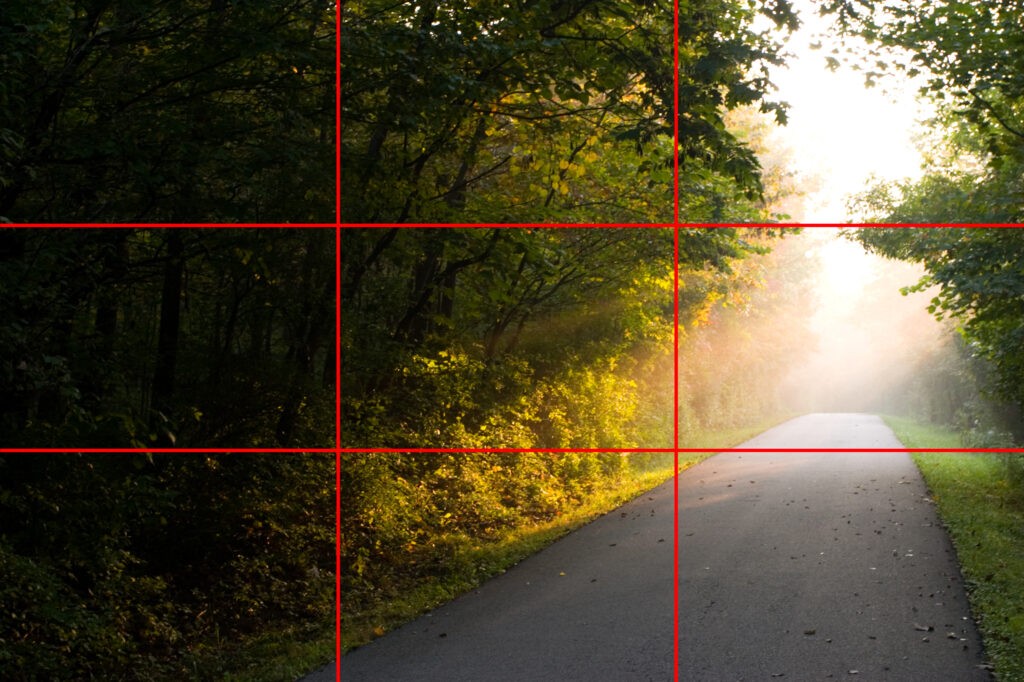 The “rule of thirds” is a rule of thumb in the composition of visual images such as photography, graphic designs and painting. It can be applied to any subject to improve the composition and balance of your images to make your design more engaging. The rule of thirds involves mentally dividing up your image using 2 horizontal lines and 2 vertical lines. You then position the important elements in your scene along those lines, or at the points where they intersect. You want to use the rule of thirds, both horizontally and vertically by placing your subject in the right or left third of the photo–this stimulates the viewer to spend more time looking at your photo. The idea is that an off-center composition is more pleasing to the eye and looks more natural than one where the subject is placed right in the middle of the frame. It also encourages you to make creative use of negative space, the empty areas around your subject.
If your photo is of a landscape, avoid putting the horizon line in the middle of the photo because this tends to make the photo feel like it’s split in two. Instead, place the horizon line along one of the horizontal lines of thirds. Make sure any focal point of the picture is placed at one of the points where the horizontal and vertical lines meet to serve as an “anchor” for the image.
If your picture is of a person, remember that the eyes are where we are naturally drawn to, so put the eyes level with one of the horizontal lines of thirds or at one of the points where the horizontal and vertical lines intersect to make a much more interesting photo and not a “mug shot” (where the subject is centered in the middle of the frame).
Why Weak Visual Content Limits Growth
Many businesses rely on inconsistent visuals that do not support their message. This creates weak content and messaging that confuses audiences and reduces trust. Without strong social media photography, brands lose attention within seconds.
Social media users decide almost instantly whether to engage. Studies from HubSpot show that content paired with visuals receives 94 percent more views than content without images. That means poor or inconsistent visual marketing strategies directly reduce visibility and social media engagement.
In Orlando, FL, where competition spans tourism, service industries, and local businesses, eye-catching images matter more than ever. When content writing does not match the visual style, audiences disconnect from the message.
Strong social media photography fixes this gap by delivering clarity, emotion, and relevance. Combined with structured photo enhancement tips, brands can quickly improve the quality of their content without overcomplicating production.
If your business struggles with inconsistent branding, it is time to rethink your visual approach and strengthen your messaging through better strategy.
Audience Targeting Through Smarter Visual Strategy
Audience targeting is essential because every industry competes for attention. Weak content and messaging often come from not understanding who the content is speaking to. Strong visual marketing strategies solve this problem by aligning design and communication with audience expectations.
Social media photography plays a major role in audience connection. When visuals reflect the lifestyle, tone, and expectations of your target market, engagement improves naturally. Businesses that invest in intentional imagery see stronger social media engagement because their content feels relevant and authentic.
Content writing must reinforce what the visuals communicate. When both elements work together, brands deliver a clear message that builds trust. Eye-catching images alone are not enough without supporting context.
We often help businesses improve results by applying simple photo enhancement tips such as adjusting lighting, improving composition, and refining color balance. These small improvements transform average posts into eye-catching images that drive attention.
At The AD Leaf, we build campaigns where social media photography and content writing work as a unified system. This approach improves social media engagement and strengthens long-term brand recognition.
Building High-Quality, Consistent Content That Performs
Consistency is one of the most important factors for success in digital marketing. Businesses that post high-quality, consistent content outperform those that post irregular or unplanned content.
Social media photography must follow a clear visual identity. This includes tone, framing, and brand style. When businesses maintain consistency, audiences begin to recognize their content instantly.
Content writing must also stay aligned with visual direction. When messaging and imagery match, brands create stronger emotional connections. This alignment improves social media engagement and strengthens marketing performance across platforms.
Using structured photo enhancement tips ensures every post meets a quality standard. Even small adjustments can elevate visuals into eye-catching images that perform better in crowded feeds.
Strong visual marketing strategies also support SEO and cross-channel visibility. For businesses, consistency builds trust, and trust drives conversions. Without it, even strong campaigns lose momentum.
Turning Visual Content Into Engagement-Driven Assets
Every post a business publishes should serve a purpose. Social media photography should not exist just for aesthetics. It should support engagement, awareness, or conversion.
When paired with strong content writing, visuals become powerful communication tools. Businesses that use intentional visual marketing strategies see higher social media engagement because their content tells a clear story.
Eye-catching images help capture attention, but strategy keeps users engaged. That is where photo enhancement tips become valuable. Adjusting contrast, sharpening details, and improving composition can significantly increase performance without requiring expensive production.
In Orlando, FL markets, competition is high, so even small improvements in social media photography can create noticeable results. Over time, consistent improvement leads to stronger brand recognition and better engagement metrics.
Aligning Messaging With Design for Better Results
Weak content and messaging often come from disconnects between creative teams. We see businesses struggle when graphic design, content writing, marketing, and social media operate independently.
Strong visual marketing strategies solve this by aligning all creative output. Social media photography becomes more effective when it supports a unified message. Eye-catching images must reinforce what the brand stands for, not distract from it.
When businesses apply structured photo enhancement tips, they ensure every visual meets brand standards. This improves consistency and strengthens recognition across platforms.
Social media engagement increases when audiences receive clear, cohesive messaging. Confusion reduces interaction, while clarity builds trust and action.
Why The AD Leaf
At The AD Leaf Marketing Firm, our Orlando, FL team helps businesses eliminate weak content and messaging by building structured, results-driven marketing systems. We integrate content writing, graphic design, marketing, and social media into one unified strategy.
We specialize in developing high-quality, consistent content that strengthens brand identity and improves performance. Through strategic social media photography, advanced photo enhancement tips, and intentional visual marketing strategies, we create eye-catching images that increase social media engagement and improve audience targeting for businesses in Orlando, FL.
If your business is ready to improve its digital presence, now is the time to act.


 Brand awareness refers to the extent to which a target audience can recognize and recall a brand. It’s not just about having a memorable logo or a catchy tagline; it’s about creating a lasting impression in the minds of consumers. When individuals think of a particular product or service, a strong brand awareness campaign ensures that your brand is the first to come to mind.
 Paid Advertising: Utilize social media advertising to target specific demographics and expand your brand’s reach.
 The final step in getting ready for social media is posting and scheduling content for your platforms to share. Content on social platforms is going to look slightly different from one another; for example, Facebook captions will contain links and more information than a regular post, whereas Instagram cannot have links in their captions, so the information is in a graphic or linked in the bio. Twitter captions should be short and sweet due to their character limitations, and Pinterest should have graphics with more information in them.


